Human trials, animal tests and their endpoints
My applause depends on the outcome being measured. Sleep recordings, alertness, hormones and motor tests answer different questions.
Insomnia: latency, efficiency and alertness
In the 1992 double-blind insomnia study, sleep latency—the time spent waiting to fall asleep—shortened, and sleep efficiency improved against placebo. The authors still described modest effects and doubted that short-term treatment alone would offer major therapeutic benefit. I trust a paper more when its conclusion respects the size of its finding.
The 1981 pilot in six chronic insomniacs reported longer sleep, fewer interruptions, slightly more REM sleep and no adverse daytime effects. The 1987 study in 14 middle-aged chronic insomniacs followed sleep and waking behaviour through a seven-night intravenous course. Sleep efficiency reached normal-control levels, daytime alertness and performance improved significantly, and benefit persisted into the first post-treatment placebo night.
These favourable results deserve to survive a skeptical review. So does the later assessment of inconsistent sleep evidence. My ideal insomnia trial would measure the recorded night, the sleeper’s assessment and next-day function together; the older findings have yet to receive that sort of decisive replication.

Withdrawal and chronic pain
The 1983 open withdrawal pilot enrolled 67 people: 28 with alcohol dependence and 39 with opioid dependence. Somatic withdrawal signs were alleviated in 48 of 49 evaluable subjects, reported as 98%, with immediate onset and no major adverse events. Psychological symptoms eased more gradually. The evaluable group matters to that striking percentage, and the open design leaves a great deal for a controlled replication to resolve.
My first reaction to the size of the response was interest; my second was to ask how confidently the study could attribute it. The authors proposed opioid-system involvement. Their proposal supplies a hypothesis, while a dedicated DSIP receptor remains unidentified.
The chronic-pain pilot reported reduced pain in 6 of 7 people and lower depressive-symptom scores. The conditions included migraine, vasomotor headaches, chronic tinnitus and psychogenic pain. Small exploratory groups like these can make an idea worth testing without establishing a treatment effect that transfers to routine care.
Hormones, seizures and proposed mechanisms
The growth-hormone experiment in ovariectomized rats combined brain injections with isolated pituitary-cell work. Growth-hormone release increased, and the dopamine antagonist pimozide blocked the effect in the animal work. In a separate sleep-deprivation experiment in male rats, anti-DSIP antiserum blocked the rebound in slow-wave sleep and the accompanying growth-hormone rise. These are animal and cell findings.
The metaphit-induced epilepsy model in adult male Wistar rats showed lower seizure incidence, duration and severity alongside higher delta-wave EEG power. The rat findings leave human endocrine and anticonvulsant effects unestablished.
Proposed explanations range across inhibitory signalling, the stress-hormone system, dopamine and endogenous opioids. The review of the mechanism problem is the necessary companion to those accounts: there is still no conclusively identified DSIP gene, precursor or specific receptor. I resist the tidy version in which a collection of proposed pathways adds up to a settled mechanism.
Cell respiration and mouse longevity
In the rat hypoxia and isolated-mitochondria experiments, DSIP pretreatment protected mitochondrial respiratory activity against the experimental oxygen shortage; isolated rat brain mitochondria also showed improved ADP phosphorylation efficiency in vitro. That last measurement concerns the energy-making machinery inside cells.
The aging-rat antioxidant work reported lower lipid peroxidation and increased activity of antioxidant systems, including superoxide dismutase, catalase and ceruloplasmin, alongside elevated uric acid. These biochemical outcomes interest me as possible explanations to investigate.
The Deltaran longevity study in female SHR mice used a DSIP-containing preparation. It reported 2.6-fold lower spontaneous tumour incidence, 22.6% fewer bone-marrow chromosome aberrations and 24.1% greater maximum lifespan. Those figures describe that preparation in those mice. The work comes from a related research lineage and lacks the separate replication needed for a broad longevity conclusion.
Rat stroke recovery: two outcomes
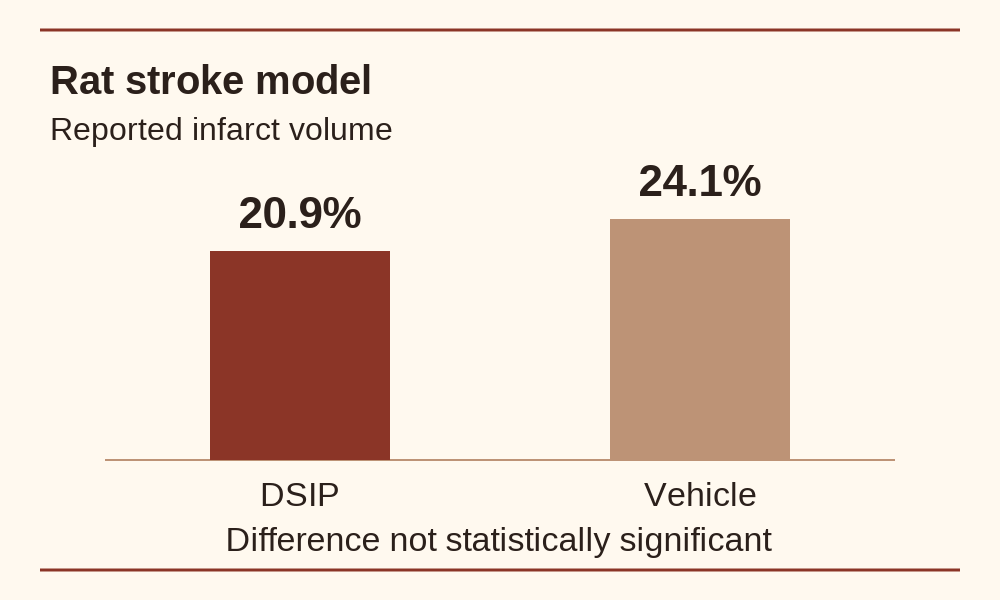
The 2021 focal-stroke experiment in adult male Sprague-Dawley rats is an especially useful test of what a favourable review means. Motor coordination on the rotarod recovered to normal by day 7. Yet the reported infarct volumes were 20.9% with DSIP and 24.1% with vehicle, a difference that was not statistically significant.
I value the recovered coordination without demanding a smaller infarct. It gives no basis for a claim that the damaged brain area shrank. The experiments measured both. This remains a rat study, with no demonstrated human stroke-recovery benefit.
Engineered DSIP and the blood measurement
The 2024 Pichia pastoris fusion-peptide study tested DSIP-CBBBP, an engineered construct, in male Kun-Ming mice with PCPA-induced insomnia. Daily wakefulness fell from 720 to 500 minutes, a reported 31% reduction with p<0.0001; the fusion outperformed native DSIP and GABA. Serotonin, melatonin and dopamine levels were restored, anxiety-related behaviour decreased and hippocampal neuron density improved. All of this was mouse-model work on the fusion construct.
The chemical identity deserves to travel with the result. I won’t transfer a fusion construct’s success to its parent molecule.
A different kind of experiment measured morning plasma DSIP-like immunoreactivity in 10 people with narcolepsy, 9 with sleep apnea and 11 controls. The groups showed no statistically significant differences. That blood measurement supplied no reliable diagnostic separator. Nor does the single narcolepsy case report—which described fewer sleep attacks and better alertness—establish efficacy across people with narcolepsy.
Sequence and physiological identity
The 1977 rabbit paper characterized the sequence Trp-Ala-Gly-Gly-Asp-Ala-Ser-Gly-Glu, abbreviated WAGGDASGE. The 1984 characterization review describes a peptide reported across tissues and fluids, carrier-protein binding, blood-brain-barrier transport, strict structural requirements and a phosphorylated form with greater activity in some assays. Sleep-stage effects varied across animal species, including a preference for REM in cats in the reviewed work.
The breadth of that account is fascinating. It is also why my verdict stops at the experiment’s edge, however appealing a single glowing assessment of DSIP might be. The dose and clearance page adds the study parameters; the source list makes the wider record available.